€100 to €300 per session, six to ten appointments spread across half a year to a full year — that’s the real math behind laser hair removal for legs in Munich, before the first smooth summer weeks arrive. Anyone who only googles “price per session” usually gets half the answer. This article shows the concrete price table for half and full legs, explains the session plan, and makes clear what’s realistic to expect after six months — without promises no studio can keep.
How Much Does Laser Hair Removal for Legs Cost in Munich?
At MONLIS Studio, a session for the lower legs costs €100 to €200, and for the full legs €150 to €300 — depending on skin condition, treatment time, and individual treatment plan.
Studios in Munich generally range from about €170 to €400 per session for legs, depending on equipment, location, and whether it’s a medical cosmetic institute or a dermatology practice. Two studios in the same district can differ significantly for the same area without the quality necessarily being different — which is exactly what makes price research so tedious for many people.
| Area | Price per session | Full series (6–8 sessions) |
|---|---|---|
| Lower legs / half legs | €100–200 | €600–1,400 |
| Full legs | €150–300 | €900–2,100 |
For comparison: an upper lip session at MONLIS costs €30–60, underarms €50–100, and the bikini area €60–120 per session. Legs are considerably higher simply because the surface area is larger and a session accordingly takes longer — for full legs, between 45 and 60 minutes.
A comparison that surprises many: according to MONLIS’s own estimate, someone who gets professionally waxed every four weeks pays a similar amount over two years as for a complete laser series — just without a lasting effect at the end. This comparison comes from the studio’s own calculation and serves as a rough guide, not an independently verified figure. Booking multiple sessions as a package saves an additional 20 to 30% at MONLIS compared to individual appointments.
What Determines the Price?
The price depends primarily on three factors: the size of the area, skin and hair type, and the laser technology used.
The larger the area, the longer the treatment time — and the higher the price. Full legs take almost four times as long as the lower legs alone. When it comes to skin type, contrast is what matters. The diode laser works based on the difference between dark hair and lighter skin. Dark hair on light to medium skin (Fitzpatrick type I–IV) delivers the most reliable results; on very dark skin (Fitzpatrick V–VI) treatment is possible with adjusted, more experienced settings. With blonde, red, and grey hair, however, the contrast is usually not sufficient for reliable results. An individual consultation with a skin analysis clarifies this in advance — for more on which body areas are generally suitable for laser treatment, see our overview of treatable body areas at MONLIS.
MONLIS uses modern diode lasers that can be adjusted for different skin and hair types. Before every first treatment, a skin analysis with a test pulse is carried out to optimize the settings individually.
The result always remains individual. With consistent use of the full session plan, a noticeable improvement is possible — no studio can seriously give a blanket guarantee, because hormone levels, hair density, and skin reaction vary from person to person. Anyone who is pregnant, taking photosensitizing medication, or has recently tanned skin in the treatment area should mention this openly before the first session — in such cases, a treatment may need to be postponed or adjusted.
How Many Sessions Do You Need for Smooth Legs?
For the legs, six to ten sessions spaced four to eight weeks apart are generally recommended, depending on the studio and individual hair cycle; some sources — including MONLIS itself — sometimes cite six to eight sessions with somewhat shorter intervals. The exact number depends on the individual treatment plan and is determined during the initial consultation.
The reason for multiple appointments lies in the hair cycle: the laser only affects hairs that are currently in the active growth phase. Hairs in the resting or transition phase remain unaffected — and it’s precisely those that gradually “move” into the active phase with each session. That’s why it takes several appointments to really catch all the follicles. Legs tend to need more sessions than smaller areas like the upper lip, because the surface area is larger and hair growth on the upper and lower legs doesn’t always run in sync.
Here’s how progress typically unfolds over the series:
- Sessions 1–3: Hair density usually decreases visibly, and regrowing hair becomes finer.
- Sessions 4–6: Many areas are already largely hair-free, though isolated hairs may still regrow.
- Sessions 7–10: The final appointments are more about fine-tuning — remaining hairs are thin and barely visible.
After the full series, it’s worth being honest: you’re rarely “finished” in the classic sense. A few fine hairs eventually reappear for most people — that’s normal and not a sign that something went wrong. Many studios therefore recommend scheduling a touch-up session once or twice a year, especially when hormonal changes such as pregnancy or menopause can reactivate hair growth.
Anyone who bundles sessions instead of booking them individually saves 20 to 30% at MONLIS, as mentioned — over six to ten appointments, an amount that makes a noticeable difference.
Treatment Process: What Happens at MONLIS?
A session at MONLIS is divided into four steps: skin analysis, preparation, the actual laser treatment, and aftercare.
Preparation — what to keep in mind before the appointment:
- Four weeks before: no waxing, sugaring, or epilating — only shaving is allowed, since the laser needs the hair root intact in the follicle.
- Two weeks before: sunbathing, solariums, and self-tanner in the treatment area are off-limits.
- 24 hours before: the area is shaved so the hairs sit just below the skin surface.
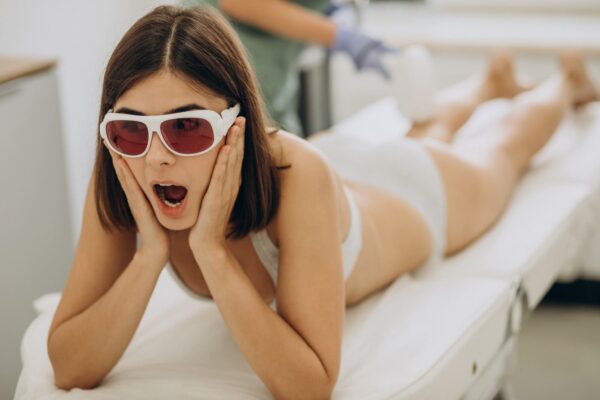
During the session itself, the team first analyzes skin condition, hair color, and skin type, and discusses openly whether and how the laser can be used optimally. The skin is then cleansed and a cooling gel is applied. The laser moves systematically across the area; modern devices automatically cool the skin between pulses, which makes the treatment noticeably more comfortable than it was a few years ago. Most people describe the sensation as a light tingling or like the quick snap of a rubber band — noticeable, but bearable for most. A soothing gel is applied at the end.
Aftercare — what matters after the treatment:
- 24–48 hours: no sports, no sauna, no hot baths.
- One week: no exfoliating in the treated area.
- At least two weeks: sunscreen with SPF 30+ is required.
Mild redness and a warm feeling on the skin in the first few hours are normal and subside on their own. Over the following two weeks, the treated hairs gradually fall out — this can briefly look like regrowth, but it’s exactly the opposite. You shouldn’t pluck them out during this phase — just wait it out.
For more on the exact process, preparation steps for the body in general, and the costs of all areas, see our detailed article on the process and cost of laser hair removal.
This article is for general information purposes and does not replace consultation with a doctor or specialist.
Results After 6 Months: What’s Realistic?
After a full session series, most clients can expect hair reduction of roughly 70 to 95% — the technical term for this is “permanent hair reduction,” not “permanent hair removal” in the absolute sense. Figures vary within this range depending on the source; how much reduction occurs in individual cases depends on skin type, hair density, and adherence to the session plan. A higher number at the upper end of this range is realistic but not guaranteed.
This distinction between reduction and removal is more than semantics. Even after a completed series, a few fine hairs can occasionally regrow, especially with hormonal changes from pregnancy, menopause, or certain medications. An occasional touch-up session keeps the result stable.
The scientific literature on diode lasers also supports this range: a study by Wheeland (Lasers in Surgery and Medicine, 2012) examined a diode laser device over eight treatments. Immediately after completing the treatment series, measured hair reduction ranged from 47 to 73% depending on the energy used; twelve months after the last session, it had dropped to 44 to 65% — so the effect remained largely stable over the year, though somewhat weaker than immediately after treatment. This figure should, however, be read with caution before applying it to a studio setting: the study tested a home-use device on just 13 people; professional studio devices, like those used at MONLIS, operate under professional supervision with higher and individually adjusted energy, which generally leads to stronger effects than home use. The study therefore provides more of a lower baseline than a direct prediction for professional treatments.
Between the first three sessions, the difference is usually still moderate; the noticeable jump typically happens between sessions 4 and 6, once most active follicles have already been hit multiple times. After six months — depending on the individual session plan, that’s roughly four to six appointments — many clients already report noticeably less and finer hair growth, even if the series isn’t fully complete at that point.
Laser vs. Sugaring/Waxing for Legs — Which Is Worth It?
Sugaring scores with skin-friendliness and immediate results with no waiting time; laser, on the other hand, scores with significantly reduced regrowth in the long term after a completed series.
Sugaring uses a paste made from natural ingredients and removes hair along with the root — gentle on sensitive skin, but with limited lasting effect, since the hair root itself stays intact. Laser hair removal, by contrast, targets the follicle’s growth cell and requires several sessions over months, but delivers a significantly longer-lasting result afterward. Which method suits you better depends on skin type, pain tolerance, and whether you’re looking for a short-term or long-term solution — a detailed comparison can be found in Sugaring or Laser — Which Is Better for Legs?.
Everything in One Place — Your Laser Hair Removal at MONLIS
MONLIS operates three studios in the center of Munich — Goetheplatz, Westpark, and Karlstraße — with certified specialists and modern diode laser devices individually adjusted to skin and hair type. Over 10,000 clients have already chosen a treatment at MONLIS — an experience base reflected in the ongoing fine-tuning of treatment parameters.
Every treatment begins with a skin analysis and a test pulse, so the settings can be optimized before the first full session. The service is multilingual — German, English, and Russian are covered by the team at minimum, often Ukrainian as well — which is especially practical for international clients in Munich. Anyone unsure whether laser is even the right choice can arrange a no-obligation consultation: skin type and hair growth are assessed there, and it’s discussed honestly whether and how many sessions make sense.
For legs, laser hair removal in Munich realistically means: €100 to €300 per session depending on the area, six to ten appointments spread over several months, and afterward a noticeable — but not absolute — reduction in hair growth. Knowing the numbers makes it easier to judge whether the investment is worthwhile — and anyone looking for a no-obligation assessment of their own skin type will find a good first point of contact at the three MONLIS studios in Goetheplatz, Westpark, and Karlstraße.
Book a no-obligation consultation at MONLIS now:
Looking for a gift for someone else? That’s easy to solve too — with a MONLIS gift voucher.
This article is for informational purposes only and does not replace consultation with a doctor or a qualified skincare specialist. If you are pregnant, taking photosensitizing medication, or have recently tanned skin in the treatment area, this should be discussed openly with the studio before the first session.
Frequently Asked Questions
Generally six to ten sessions spaced four to eight weeks apart, sometimes six to eight sessions with somewhat shorter intervals — the exact number depends on skin type, hair density, and your individual hair cycle, and is determined during the initial consultation. After the full series, most clients can expect a hair reduction of roughly 70 to 95%.
At MONLIS, a session for the lower legs costs €100 to €200, and €150 to €300 for full legs. Booking multiple sessions as a package saves an additional 20 to 30% compared to individual appointments.
Most people describe a light, warm tingling, comparable to the snap of a rubber band — noticeable, but bearable. Modern diode lasers with built-in contact cooling significantly reduce discomfort compared to older devices.
Treated follicles generally produce noticeably less or no hair going forward. However, hormonal changes such as pregnancy or menopause can reactivate individual dormant follicles. An occasional touch-up session, roughly once a year, keeps the result stable.
Yes, it’s even necessary: the area should be shaved 24 hours before the appointment so the hairs sit just below the skin’s surface. Waxing, sugaring, or epilating, on the other hand, should be paused four weeks beforehand, since the laser needs the hair root intact in the follicle.